


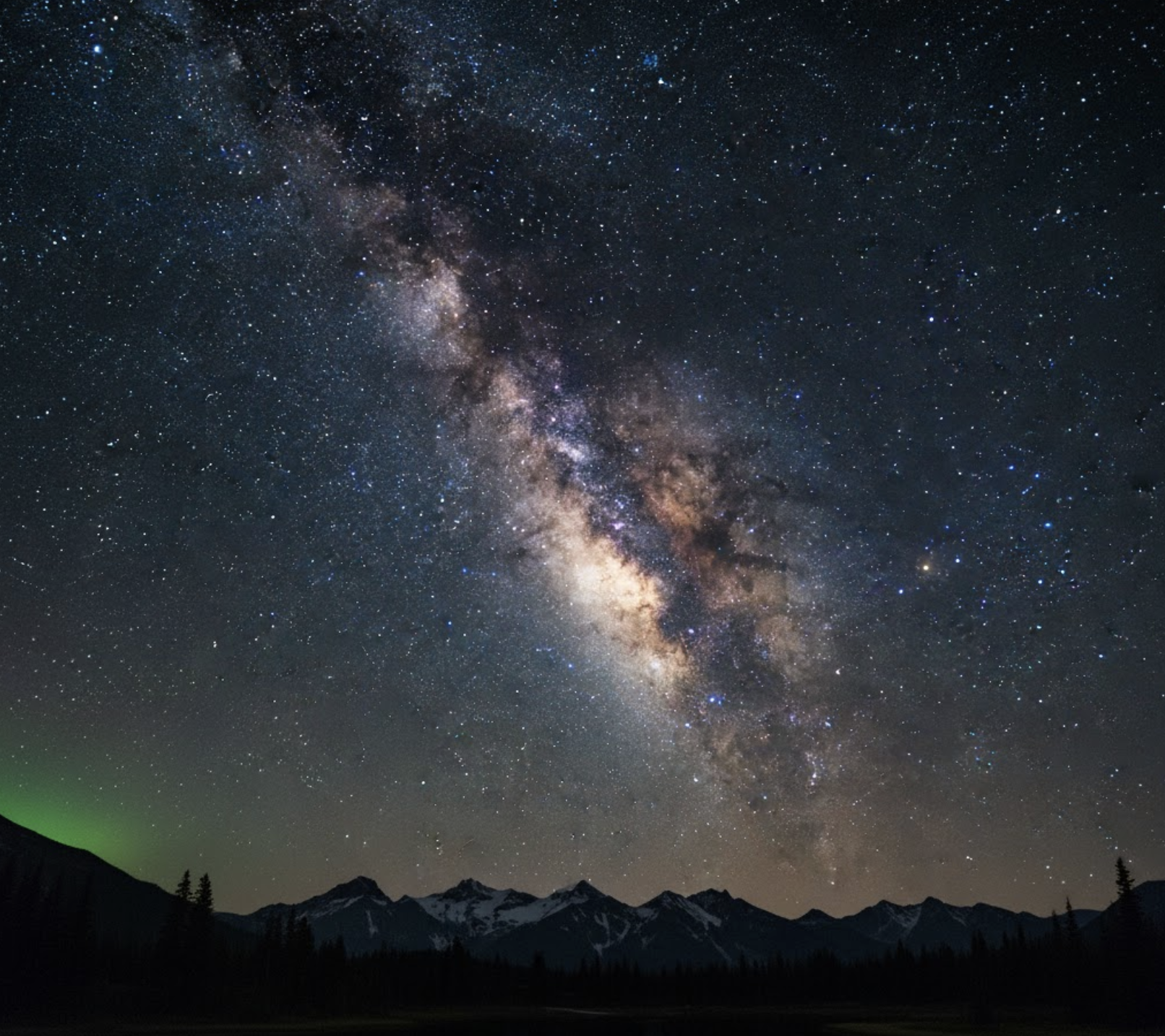
🌌 The Magnificent Milky Way: Our Galactic Home
When you look up at a clear night sky far from city lights, you might see a faint, misty band stretching across the heavens. That glowing river of light is the Milky Way Galaxy — our cosmic home among billions of others in the universe. But beyond its beauty lies a story of immense scale, complexity, and cosmic wonder.
🌠 What Is the Milky Way?
The Milky Way is a barred spiral galaxy — a vast collection of stars, planets, gas, dust, dark matter, and cosmic energy bound together by gravity. It spans about 100,000 to 120,000 light-years across and contains over 200 billion stars, including our very own Sun.
🌀 Structure of the Milky Way
- Galactic Center (Bulge)
At the heart of the Milky Way lies a dense region of stars surrounding a supermassive black hole known as Sagittarius A*. This black hole has a mass about 4 million times that of the Sun. - Galactic Disk
The disk is where most of the galaxy’s stars, planets, and nebulae reside — arranged in spiral arms filled with glowing gas and dust. The Sun sits on the Orion Arm, a minor spiral arm located about 27,000 light-years from the center. - Halo and Globular Clusters
Surrounding the disk is a spherical halo of old stars and globular clusters — ancient star systems that date back nearly to the galaxy’s formation. - Dark Matter Halo
Enveloping everything is an invisible halo of dark matter, which scientists believe makes up most of the galaxy’s mass, holding it together through gravity.
🌞 Our Place in the Milky Way
Our solar system orbits the galactic center at a speed of about 828,000 km/h (514,000 mph). Even at that speed, it takes roughly 225–250 million years to complete a single orbit — known as a galactic year.
🌟 The Life of the Galaxy
The Milky Way formed about 13.6 billion years ago, not long after the Big Bang. Since then, it has grown through mergers with smaller galaxies — a process that still continues today. In fact, the Milky Way is on a slow collision course with our nearest large neighbor, the Andromeda Galaxy, which it will merge with in about 4 billion years, forming a new “supergalaxy” sometimes called Milkomeda.
🔭 Observing the Milky Way
- Best seen: From dark-sky locations away from light pollution
- Visible features: Dust lanes, star clusters, and nebulae such as the Lagoon Nebula or Eagle Nebula
- Fun fact: The name “Milky Way” comes from the Greek “Galaxias Kyklos”, meaning “milky circle.”
💫 A Cosmic Perspective
The Milky Way is just one of over two trillion galaxies in the observable universe — yet it is our home. Every star you see in the night sky belongs to this single galaxy, a reminder that even within the vastness of the cosmos, we are part of something grand and interconnected.
“The cosmos is within us. We are made of star-stuff.” — Carl Sagan