


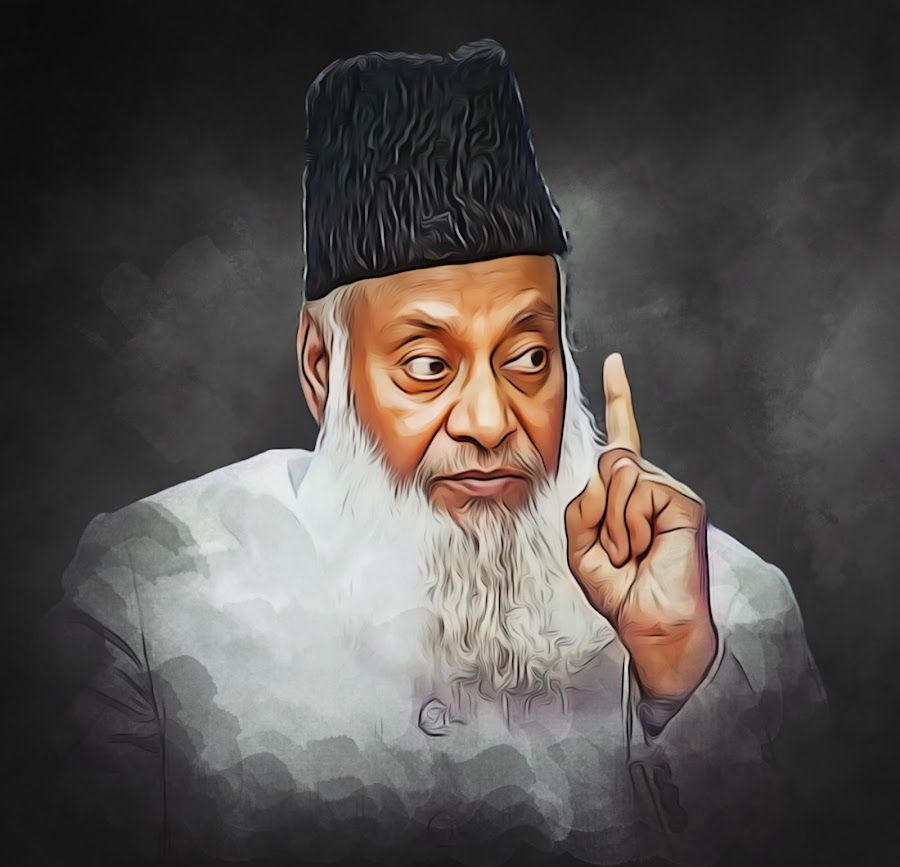
Dr. Israr Ahmed (1932–2010) devoted his scholarship and public work to restoring a Qur’an-centric consciousness among Muslims. Drawing on classical tafsir, disciplined study circles, broadcast teaching, and institution-building, he tried to reconnect individuals and society with the Book—intellectually, spiritually, and practically. This profile summarizes his life and Qur’anic project from sources that honor his legacy, including his own organizations and publications.
Early Life, Study, and Turn to Qur’anic Work
Born on April 26, 1932, in Hisar (then East Punjab, now Haryana, India), he migrated to Pakistan after Partition. He earned an MBBS from King Edward Medical College (1954) and later an M.A. in Islamic Studies from the University of Karachi (1965)—a dual formation that shaped his method: traditional faith with scientific clarity.
As a young activist, he briefly worked with Islami Jami‘yat-e-Talaba and Jama‘at-e-Islami, then stepped away over methodological differences while continuing dars-e-Qur’an across Pakistan. In 1972, he founded Markazi Anjuman Khuddam-ul-Qur’an (Lahore) to build a public movement of Qur’anic learning, and in 1975, he established Tanzeem-e-Islami.
Institutions and Platforms of Teaching
Dr. Israr’s Qur’anic message reached people through multiple channels.
- Khuddam-ul-Qur’an / Qur’an Academy (Lahore): home to classes, publications, and the journal The Qur’anic Horizons.
- Broadcast series and public lectures: his televised dars made the Qur’an’s message accessible to a broad Urdu-speaking audience.
Bayan-ul-Qur’an: His Signature Tafsir Project
The heart of his legacy is Bayan-ul-Qur’an—a complete Urdu commentary delivered as lectures and compiled in multi-volume form. The Qur’an Academy’s library hosts the set (classic and new editions), and Tanzeem-e-Islami provides recordings and derivatives for study.
Method in brief:
- Fidelity to classical Sunni tafsir.
- Attention to nazm (internal coherence of the Qur’an).
- Presentation in a contemporary, clear, and rational language for modern readers.
“The Obligations Muslims Owe to the Qur’an”
A concise statement of his program appears in the booklet The Obligations Muslims Owe to the Qur’an (based on 1968 addresses). He summarized five duties the Qur’an makes of every believer:
- Believe in it.
- Read and recite
- Understand
- Act upon it.
- Convey it to others.
These five principles formed the backbone of his teaching, institution-building, and public lectures.
Related Writings and Resources
Among his many works, the most influential are Bayan-ul-Qur’an (Urdu, multi-volume), The Obligations Muslims Owe to the Qur’an, The Objective and Goal of Muhammad’s Prophethood, and The Basis for Organization of a Revivalist Party in Islam. His journal The Qur’anic Horizons and numerous booklets and recorded lectures continue to circulate widely in print and online.
Legacy
Dr. Israr Ahmed passed away on April 14, 2010, leaving behind more than sixty Urdu works and a living network of Qur’anic study circles, institutes, and freely accessible archives of his dars-e-Qur’an in Urdu and English. His legacy is not only a bookshelf but a method: return to the Qur’an, study it systematically, internalize its guidance, and carry it into personal and collective life.
Quick Timeline
- 1932 — Born in Hisar, India.
- 1954 — MBBS, King Edward Medical College (Lahore).
- 1965 — M.A. in Islamic Studies, University of Karachi.
- 1972 — Founding of Khuddam-ul-Qur’an / Qur’an Academy (Lahore).
- 1975 — Founding of Tanzeem-e-Islami.
- 2010 — Passed away in Lahore; his tafsir and lectures continue to be published and taught.
Conclusion
Dr. Israr Ahmed’s mission was to awaken the Muslim world through the Qur’an. His message was simple but transformative: that revival begins not with slogans or politics, but with understanding, living, and conveying the Qur’an.
His lifelong work remains a reminder that the Qur’an is not a book to be recited in ritual only—it is a living guide meant to shape intellect, character, and civilization.