


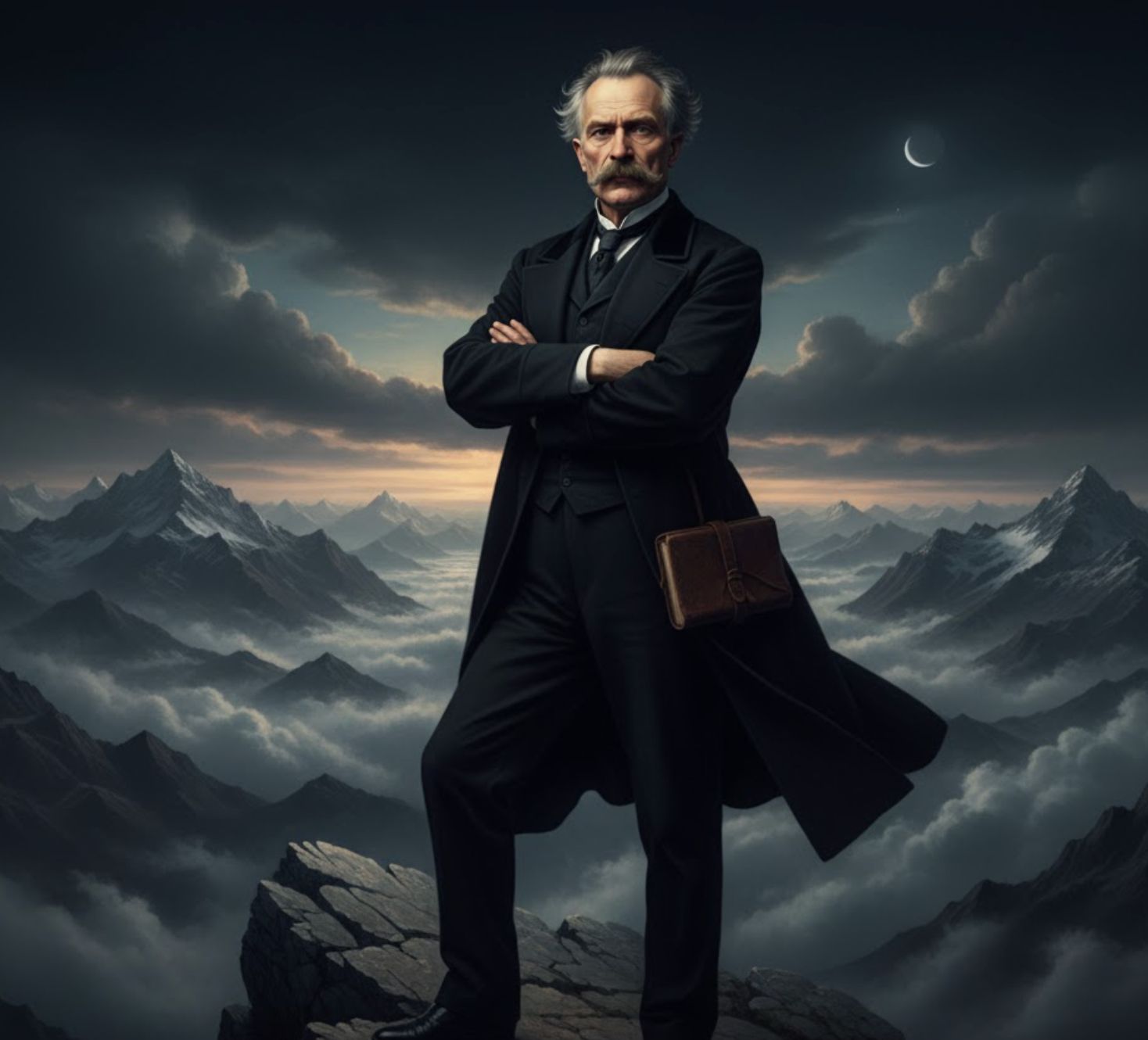
Friedrich Nietzsche (1844–1900) remains one of the most challenging and influential thinkers in modern philosophy. His writing questions morality, truth, religion, art, and even the value of human existence—yet he does so not from hostility, but from a deep desire to understand what it means to live authentically in a world without certainty. Though often misunderstood or misused, Nietzsche’s work continues to shape philosophy, psychology, literature, and cultural thought.
This post takes a non-religious, non-political look at Nietzsche’s life and ideas—focusing on his philosophical journey, his style, and the enduring relevance of his work.
Early Life and Education
Friedrich Wilhelm Nietzsche was born on October 15, 1844, in Röcken, a small village near Leipzig, Germany. His father, a Lutheran pastor, died when Nietzsche was just five years old, and his mother raised him with his sister Elisabeth in Naumburg. A gifted student, Nietzsche showed early interest in language, music, and literature.
He studied classical philology (the study of ancient languages and texts) at the universities of Bonn and Leipzig, where he was deeply influenced by the works of Arthur Schopenhauer and Richard Wagner. His sharp intellect earned him, at just 24, a professorship in classical philology at the University of Basel in Switzerland—an extraordinary achievement for his age.
From Classical Scholar to Radical Philosopher
While Nietzsche began his career studying ancient Greek texts, he gradually turned to the philosophical questions beneath them—about meaning, creativity, and human values. His early admiration for Wagner and Schopenhauer gave way to disappointment as he developed his own independent outlook.
His first book, The Birth of Tragedy (1872), explored how ancient Greek tragedy balanced two opposing forces:
- The Apollonian, representing order, clarity, and reason.
- The Dionysian, representing chaos, emotion, and creative vitality.
Nietzsche argued that modern society had lost this balance—overvaluing rationality and suppressing the passionate, life-affirming side of human nature. This insight foreshadowed much of his later philosophy.
Breaking with Tradition
By the late 1870s, Nietzsche had left his university position due to poor health and a growing disillusionment with academic life. He began to live a life of solitude, moving between the mountains of Switzerland, Italy, and southern France. During this time, he wrote his most profound and provocative works, challenging nearly every philosophical assumption of Western thought.
He called for a “revaluation of all values”—a radical questioning of morality, truth, and the concept of God. Yet Nietzsche’s goal was not nihilism (a belief that nothing matters), but the opposite: to find meaning without illusions, to affirm life even in its suffering and impermanence.
Major Works and Core Ideas
- Thus Spoke Zarathustra (1883–1885)
Nietzsche’s most famous and poetic work introduces the prophetic figure Zarathustra, who teaches the idea of the Übermensch (often translated as “Overman” or “Superman”). This figure symbolizes a person who creates their own values, living beyond conventional morality and embracing life creatively and courageously.
- Beyond Good and Evil (1886)
Here Nietzsche develops his critique of traditional morality and dogmatic philosophy. He argues that ideas of “good” and “evil” are human inventions—useful perhaps, but not absolute truths. He invites readers to look “beyond” them and to recognize the complexity of human drives and perspectives.
- The Genealogy of Morals (1887)
In this work, Nietzsche traces the historical origins of moral values, showing how concepts like guilt, conscience, and sin evolved from social power relations rather than divine law. He suggests that morality often arises not from purity but from resentment and weakness—an insight that reshaped ethics, sociology, and psychology.
- The Gay Science (1882, expanded 1887)
One of Nietzsche’s most lyrical works, it includes the famous declaration that “God is dead.” Contrary to popular misunderstanding, this was not a celebration of atheism but a recognition that modern society had outgrown its old sources of meaning—and now faced the challenge of creating new ones. The book celebrates curiosity, art, laughter, and the courage to face an uncertain world.
- Ecce Homo and Twilight of the Idols (both 1888)
In his final productive years, Nietzsche wrote these introspective and critical works. Ecce Homo is a semi-autobiographical reflection on his life and philosophy (“Why I am so wise,” “Why I write such good books”), while Twilight of the Idols offers sharp, witty attacks on what he called the “idols” of Western culture—traditional morality, blind faith, and empty idealism.
Key Philosophical Themes
- Will to Power
Nietzsche saw life as a dynamic struggle for expression and self-overcoming. The “will to power” is not about domination, but about the creative drive that pushes individuals—and even life itself—to grow, to become stronger, to affirm existence.
- Eternal Recurrence
He asked us to imagine living the same life, over and over, eternally. Could we embrace it joyfully? This idea was meant as a test of affirmation—an invitation to live so fully that one would wish to relive life again.
- Perspectivism
Nietzsche rejected the idea of absolute truth. Instead, he argued that all knowledge and morality come from perspectives—human viewpoints shaped by context, instinct, and experience. This idea influenced 20th-century philosophy, particularly existentialism and postmodernism.
Collapse and Legacy
In 1889, while living in Turin, Nietzsche suffered a mental collapse—reportedly triggered by an emotional breakdown in the street. He spent the remaining eleven years of his life incapacitated, cared for by his mother and sister. He died in 1900 at the age of 55.
Despite his short life and tragic decline, Nietzsche’s influence grew enormously in the decades that followed. His works inspired thinkers such as Sigmund Freud, Carl Jung, Martin Heidegger, Jean-Paul Sartre, Albert Camus, and countless writers, artists, and psychologists.
While some misused his ideas for political ends in the 20th century, Nietzsche himself rejected nationalism, racism, and dogma of any kind. His philosophy was deeply individualistic—a call for self-creation, not collective ideology.
Nietzsche’s Relevance Today
Nietzsche’s philosophy challenges us to live without ready-made answers—to question our values, to find beauty in impermanence, and to live with courage in a world that offers no guarantees. He teaches that meaning is not discovered, but created.
In an age of uncertainty, Nietzsche remains refreshingly modern: skeptical of false certainty, wary of moral rigidity, and passionate about the creative power of the human spirit.
“Become who you are,” he wrote—perhaps his simplest and most enduring challenge.
Summary
| Aspect | Details |
| Born | October 15, 1844 – Röcken, Germany |
| Died | August 25, 1900 – Weimar, Germany |
| Major Works | The Birth of Tragedy, Thus Spoke Zarathustra, Beyond Good and Evil, The Genealogy of Morals, The Gay Science, Twilight of the Idols, Ecce Homo |
| Core Ideas | Will to Power, Eternal Recurrence, Revaluation of Values, Perspectivism |
| Legacy | Influenced existentialism, psychology, and modern philosophy of culture |
Final Thought
Nietzsche was not a destroyer of meaning, but a builder of new ways to think. His philosophy is a call to live deliberately, creatively, and fearlessly—to face life’s chaos not with despair, but with affirmation. More than a century later, his voice still echoes with the same challenge:
“You must have chaos within you to give birth to a dancing star.”